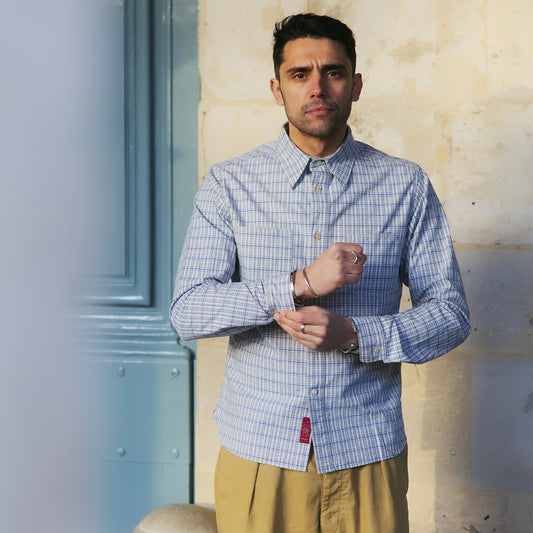
— Inspired by a 100-Year-Old French Textile Sample Book —

In the early 20th century, France produced a remarkable range of decorative textiles, from intricate jacquards to highly sophisticated printed fabrics. These were not merely products of fashion, but records of regional industry, artisanal skill, and the aesthetic sensibilities of their time.
The surviving sample books, once preserved by textile merchants, maisons, and manufacturers, contain condensed design philosophies—yarn counts, thread density, weave structures, and color compositions. Even the fading and patina that have developed over time can be read as traces of history.

PREQUEL’s textile development begins with these archives.
However, it is not a simple reproduction.
First, we deconstruct and analyze the original fabrics in detail—examining fiber types such as cotton, linen, and wool; the strength of the twist; dyeing methods; and weave structures. We also study the unique tensions of early looms, their subtle irregularities, and the shadows created by uneven yarns.
Next, together with skilled Japanese artisans, we reconstruct these structures using modern looms. Rather than pursuing perfect uniformity, we intentionally preserve a sense of irregularity, allowing the atmosphere of a century ago to exist within garments made for today.


The same philosophy applies to printed fabrics. We analyze the pigments’ depth, the way colors bled into the cloth, and the slight misalignments created by layered printing blocks. Instead of overly sharp reproduction, we design colors with an appreciation for the beauty shaped by time.


PREQUEL textiles are not meant to replicate the past,
but to interpret it and translate it into the future.


Designs born in early 1900s France are reconstructed as fabrics that rest naturally against the modern body, carrying more than a century of history within them.
They are archives, yet also living narratives.
As a “prequel” to the next hundred years, PREQUEL fabrics continue the story forward.


Designs from old textiles that are no longer produced today.
We carefully analyze these forgotten patterns and recreate them from the ground up in Japan’s historic textile regions.
From yarn selection and twist to dyeing methods and weave construction, every element is reconsidered through a contemporary lens—while preserving the atmosphere of the original era.


The result is a fabric with depth and density that cannot be achieved through mass production.
Crafted by skilled Japanese artisans, each textile embodies high quality while retaining a subtle sense of warmth and character.


Reviving lost designs through modern technique.
This is craftsmanship that honors the past while carrying it forward into the future.